Alright. We’ve defined our main concepts (displacement, velocity, and acceleration) and we’ve reviewed our algebra skills. It’s time to tackle the kinematics equations.
The whole point of the kinematics equations is that they mathematically describe motion. Note: they do not explain motion! We’ll worry about explaining motion later because explaining why things happen is always more difficult than merely observing that they do, in fact, happen.
The starting point for deriving (fancy physics/math speak for “developing”) the kinematics equations is an assumption that we’re going to make about our moving objects: we’re going to assume that they’re moving at constant (unchanging) acceleration*. We can guarantee that our acceleration is constant when the average acceleration 


We’ve talked about acceleration and how it represents a change in an object’s velocity over time. Let’s mathematically unpack that definition a bit:


This last line is our first kinematics equation! It relates the starting (initial) velocity 


Note that we cannot unpack the velocity in the same way because if there is an acceleration, the velocity is changing, and our unpacking of acceleration above assumed a constant acceleration. Only if the acceleration was zero (and velocity therefore constant) could we similarly write 
So if we can’t do that, what can we do? Well, let’s unpack the definition of average velocity. We know from our physics definition that 


This is our second kinematics equation! It relates our displacement (
Two down, two to go! Alright, let’s take stock of the variables in play here. We’ve got: 

into

and we find that


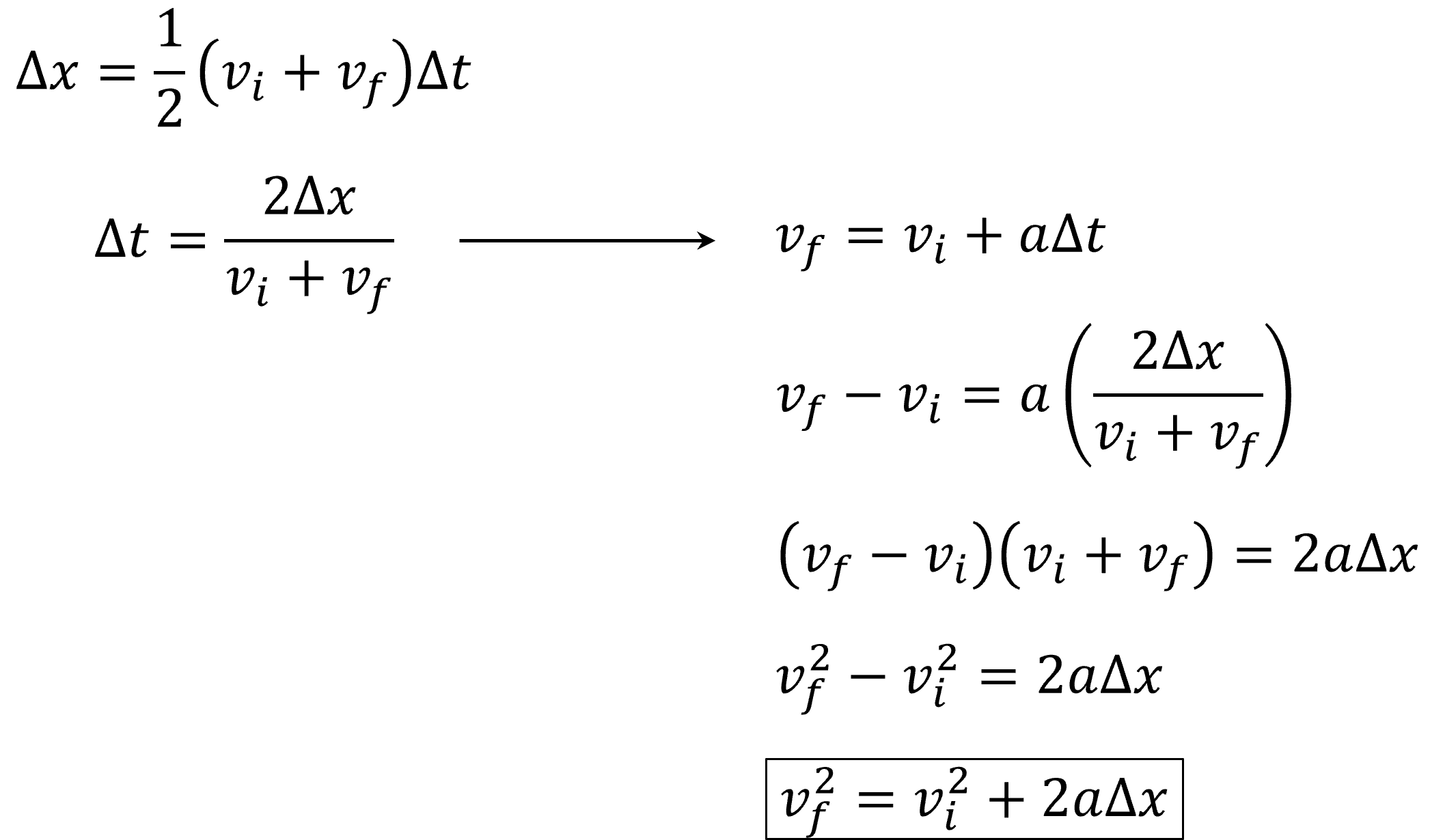
This is our third kinematics equation! The fourth and final kinematics equation relates displacement, initial and final velocity, and acceleration in one equation. This one you’re going to derive yourself – but the idea is similar to what I did above. Instead of substituting
There is, however, one thing to note: for this last equation, we will be dropping the vector hats because the concept of the “dot product” of two vectors is beyond the scope of this blog at present, and the dot product is what is necessary to correctly write this last equation generally for three-dimensional vectors. This means that you will combine 2 of the following 3 one-dimensional equations to derive your 4th kinematics equation:


Note that it does not matter which two equations you choose to do this final derivation, and I encourage you to pair them in various ways to prove to yourself that you get the same final equation every time. Behind the picture of Cheyenne is the solution based on combining the first two equations.

And that’s it! We have four equations to help us figure out how far objects have traveled, how fast they started out, how fast they ended, their acceleration, and how much time they were in motion. I’m going to reorder them slightly here and number them for future reference:

In my next post, we will talk about graphing equations (1) and (2) to take a deeper look at what they tell can tell us.
*We could mathematically deal with a changing acceleration, but this, as we will learn, would require a changing force, and to properly deal with these things, we’d need calculus, and right now, this is an algebra-based blog. (Though when we’re done with the algebra version of physics, we’ll dive in to the calculus version!)
**We are allowed to use this straightforward definition of the average because our acceleration is constant, therefore making our velocity “linear.” This just means that if we graph the object’s velocity vs. time, the graph looks like a straight line. We’ll talk more about graphing motion in my next post.

