This post is all about math, because in order to go beyond purely conceptual physics, you need to be comfortable with mathematics. It’s how physicists talk to each other; it’s the language of physics.
So, what math skills do you need to successfully follow this blog? Since I’m starting out with algebra-based mechanics, you definitely need to be comfortable with algebra. You also need to know your way around a right triangle. However, since this is not a math blog, I’m not going to try to teach you math in this post – but I will remind you of a few things.
Right Triangles
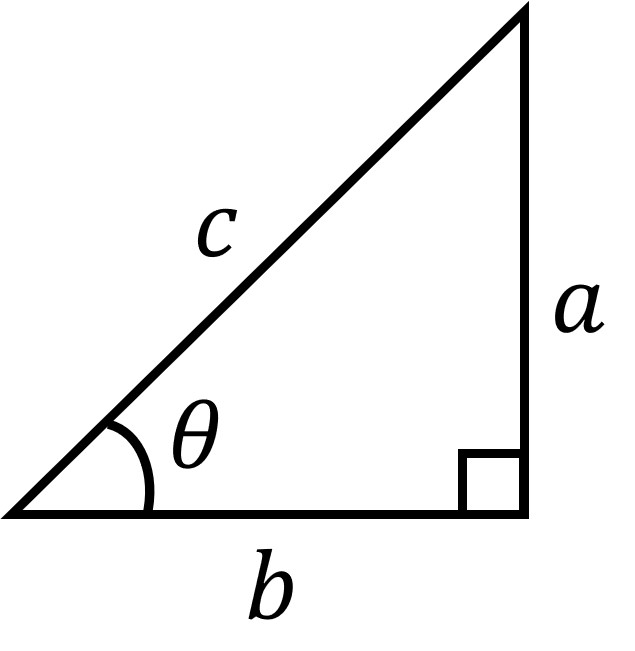
When it comes to right triangles, it’s basically about your trigonometric (trig) functions. Here we just care about the “Big 3” – sine, cosine, and tangent. These functions are all defined in relation to a given angle in the right triangle. In the triangle below, we’ll label the lower left angle with the symbol 

Notice that the “adjacent” leg of the triangle is next to


Now let’s use some variables to name the sides of the triangle. (A variable is just a letter that stands in for a number. We don’t specify what number, just that it’s some number.) We’ll use the letters 




Ok, now let’s do a what-if (which is something physicists love to do): what if we pay attention to the upper angle instead? Let’s name it with a different variable 
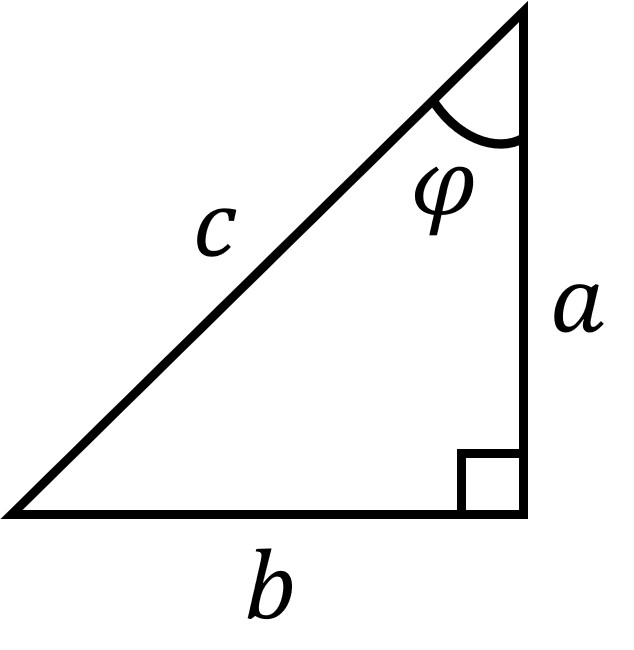
What are the three trig functions in relation to the angle

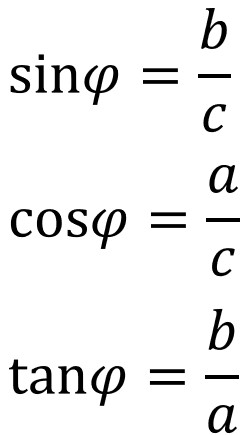
Ok, great! Now let’s compare our functions of 

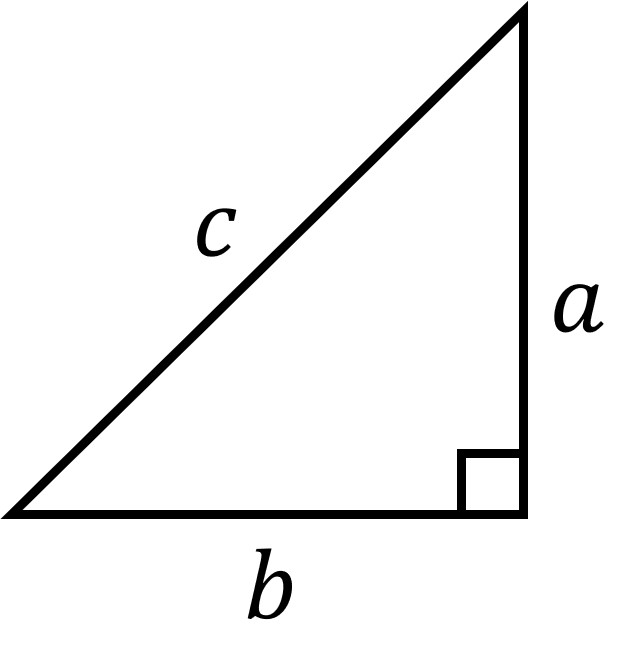
The last thing to remember about right triangles is that they follow the Pythagorean theorem. The sides of a right triangle as labeled below always obey the relationship

Algebra
When it comes to algebra, to succeed in physics, you need to be confident in manipulating equations and handling multiple equations at the same time. What do I mean by this? Well, let’s take a look at the following formula:

Right now we’re not going to worry about what the letters mean. (We’ll get to that as we learn more and more physics!) We’ll just accept that they each represent a different number, and see what we can do with them. Let’s solve for 


where I’ve listed the steps in gory detail in case it’s been awhile since you last studied algebra.
Now for a what-if: what if we’re told that 
plugging the equation for 


Now a what-if for you to try! What if we solve for 

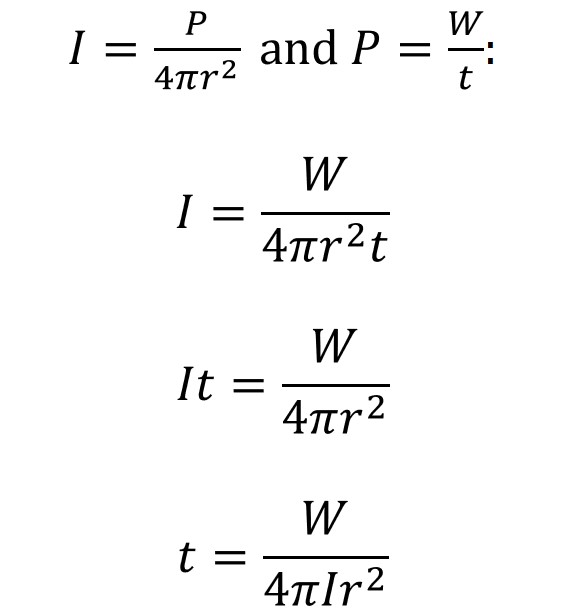
Again, I’m posting every algebraic step in case it’s been awhile, but as you get more comfortable working with variables, you may be able to skip a few steps in your mind. For example, I’ve done so much math at this point that my mind can go smoothly and quickly from 

In this blog, I won’t continue spelling out every single algebraic step, but I will try not to skip too many steps in one go when there is math to be done. You are always welcome to reach out to me if you don’t understand how I got from one line to the next in solving the math.
Finally, remember that if you have 
And that’s about it for our review: right triangles, rearranging equations, and handling multiple equations with overlapping variables. You’ve got this – on to the physics!
 Scarcely Odd